Alberto Cuadros: So, what year did K-HOLE coin the term normcore?
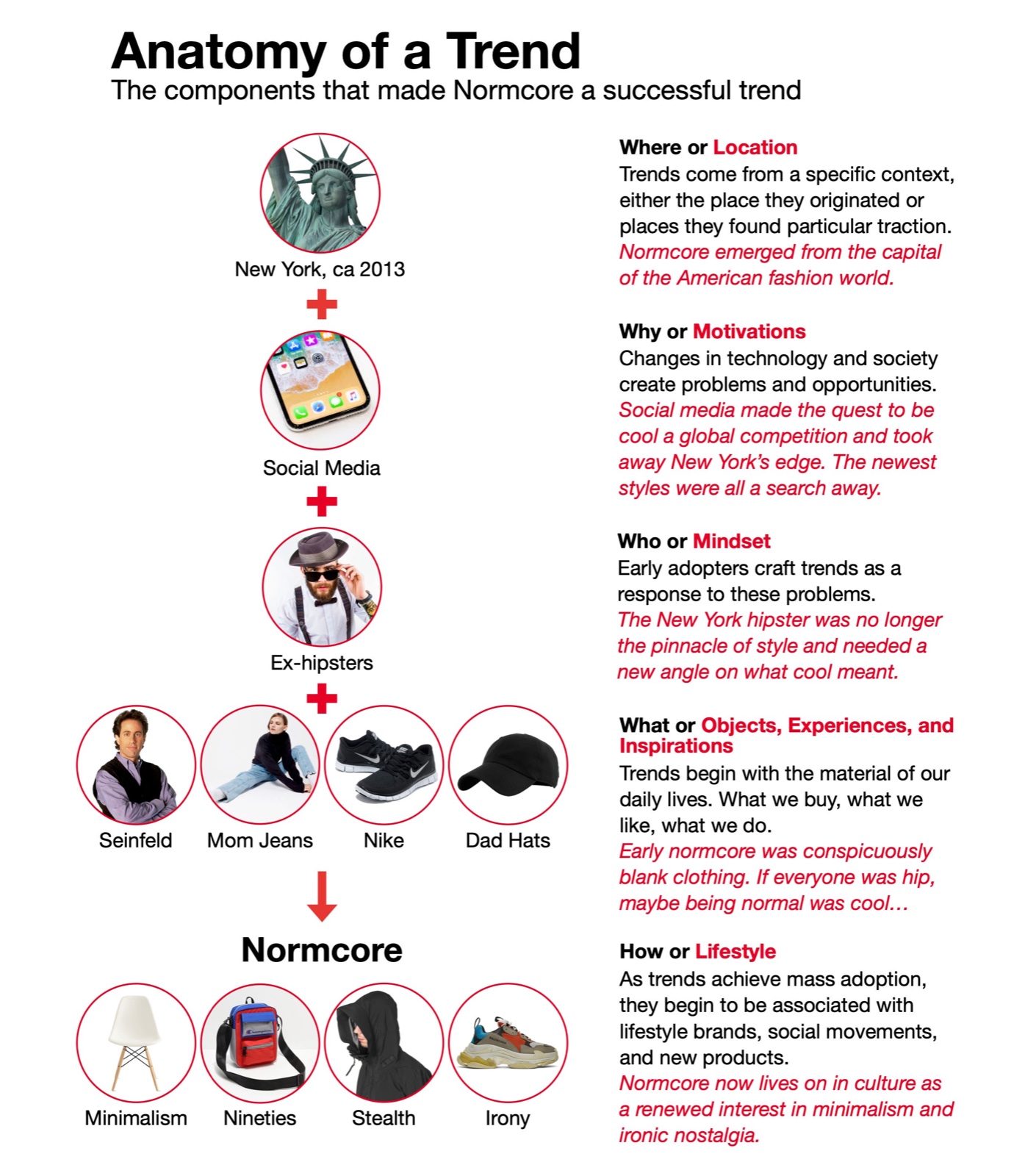
Sean Monahan: Actually in 2013. It went viral in 2014 when New York magazine wrote about it.
Alberto Cuadros: But they kind of got it wrong, right?
Sean Monahan: Um, yes and no. I think we kind of tried to make normcore utopian, but I think utopian normcore where anyone could be anything maybe ended up being killed in the cradle because the appropriate term was cultural appropriation. And so then what we called "acting basic" took on the halo of the delicious word.
Alberto Cuadros: So the idea with "acting basic" is that you could go into a different context and just appear like you fit into that context — or am I also getting it mixed up?
Sean Monahan: No, that was the idea of what normcore might be. And then the idea of "acting basic" was just, you know, dressing like a tourist, like what every major fashion designer does, what every curator does. Wearing black. It's also like people began opting into athleisure.
Alberto Cuadros: But it wasn't anti-fashion?
Sean Monahan: It was people trying to not have a style and then it became normal. It still hasn't gone away. And then it became quiet luxury. Part of the inspiration for that was Mark Zuckerberg dressing like a slob and it being a flex, which I think really came out of Silicon Valley. From the second tech boom, there was this millennial play for upper-middle-class jobs. It's going to be remembered as a very millennial life path.
Alberto Cuadros: You don't think it's happening now?
Sean Monahan: Less so. With startup culture, it's much narrower. I think the AI companies just have way less employees and the employees they do have seem way more targeted. A lot of the tech companies are all doing mass layoffs right now, right?
Alberto Cuadros: Because they overextended, probably?
Sean Monahan: Yeah. I mean, they hired a lot of people. Apparently there's a joke at Stanford that it's easier to get funded through Y Combinator than to get a job, which is probably true right now. In San Francisco, it's an industrial town, and when you meet young people there at parties, they are very clearly just interested in where you work and if you have something to offer to them. It's actually way more insane than any other place I've ever been. Way more insane than Hollywood. Way more insane than the Art World.
Alberto Cuadros: Apparently, it's going to be the new Hollywood.
Sean Monahan: I hate that. The light goes out as soon as you say you don't work in tech. They start scanning for the next person. Zuckerberg was also part of the awful quiet luxury thing.
Alberto Cuadros: Remember Facebook events? I almost forgot entirely about that community.
Sean Monahan: Yeah, I do. We already have the kind of nightmare situation of AI agents emerging. Like in the recent Atlantic article about how all the young people who recently graduated from college: people aren't hiring entry-level employees right now, so for the first time people with college degrees have a higher unemployment rate than the general population.
Alberto Cuadros: Or an opportunity for getting some really cheap labor…
Sean Monahan: The Atlantic article is basically saying young people graduating from college and using AI to write cover letters and tailor their resumes that are then sent to AI vetting systems.
Alberto Cuadros: Wow. So people are using AI to write applications for jobs that no one is reading?
Sean Monahan: Well, yeah, cuz they just go into a system. I think a lot of it is that people say they're hiring and they're not? Something like thirty percent of the jobs that are listed. When you're right out of college, you don't have a network of people unless you're an insider.
Alberto Cuadros: Hence why we're going to create the new social clubs of the future. Do you think there can be a tech moment in LA?
Sean Monahan: There kind of was one. Remember Silicon Beach? When all the startups were expanding, there was a certain tier of worker that really did not want to live in SF. The people who are doing brand work or events or PR or these kinds of more creative initiatives. And they would let those people live in New York or LA because they didn't have to pay the San Francisco wage premium then.
Alberto Cuadros: LA is the creative's capital.
Sean Monahan: Snapchat opened their offices on Venice Boulevard. I remember tech journalists used to camp out on this boardwalk. They realized they had to move to a consolidated office because they were working from a bunch of different buildings and tech journalists would go and eavesdrop.
Alberto Cuadros: I think the marketing name of Silicon Beach was more effective than what actually came out. It's really interesting to think about Howard Hughes and his connection to cinema, but then also the war and aviation industry.
Sean Monahan: That was a big part of Southern California culture, too. The military, a lot of aerospace industries were here: they got shut down or pivoted in the '90s after the Cold War. Spending just went down. People forget there was a recession in the early '90s. We never rebuilt our defense industries in California. I don't think we really have shipyards.
Alberto Cuadros: Do you think Howard Hughes cared about the technology of cinema?
Sean Monahan: Probably. Media is a tech industry.
Alberto Cuadros: This is part of what I think of when I think about SF, Muybridge, etc.
Sean Monahan: These were high-tech industries at the time. Where I grew up, near Rochester, New York, was the center of that with Kodak and Xerox. Part of the reason why the tech industry and east coast Media have never gotten along is that they are direct competitors. Social media is a decentralized version of news. Elon Musk frames these products as right. X is in the news category of apps.
Alberto Cuadros: But do you think it's just an egoic competition?
Sean Monahan: No, I think they genuinely believe that citizen journalism was a corrective to the media industry that was overly consolidated and insidery. Newspapers started having problems in the late '90s, and that wasn't entirely due to Silicon Valley. A lot of it was television news.
Alberto Cuadros: So let's go back. Back in the Citizen Kane days, the paper was the news.
Sean Monahan: Yeah. In the early twentieth century, newspapers had multiple editions per day. Elon Musk and Hearst were of similar ilk. In the newspaper era, there were multiple deliveries of mail per day. You could invite people to dinner in the mail and they could reply to you on the same day.
Alberto Cuadros: So when did the mail start going back to one time a day?
Sean Monahan: I think it's the mid-twentieth century. Every new technology starting with the printing press is a new technological revolution that's competing in some way with the last one, right? First there's the newspapers, then there's magazines.
Alberto Cuadros: What differentiates magazines from newspapers?
Sean Monahan: Frequency. Format. Also, magazines are visual. Newspapers were in trouble in the 1990s because of television. CNN started going 24-hour per day during the first Gulf War. The twenty-four-hour news cycle starts with the Gulf War because they used to stop broadcasting at a certain time. And that's the first hit to newspapers because a lot of it's just speed based. Like printing a new edition and having it delivered to everyone's house is more labor intensive.