Jasmine Sun: How do you define what a counterculture is? What makes a culture a counterculture?
Fred Turner: Countercultures are often not what their members think they are. Members often think they're outsiders pushing against the center of a system. It doesn't always work that way. Countercultures, I think, tend to be small groups broken out of a larger society that tend to build—countercultures really vary in the historical periods you're working in. […] The countercultures of the 1960s had a set of beliefs they saw as their own. They believed in small-scale technology. They believed in consciousness-raising. But those beliefs actually, though they wouldn't acknowledge it, belonged to the military-industrial establishment they were claiming to escape.
I think countercultures tend to be smallish groups that set themselves ideologically or practically against what they imagine to be a mainstream, and tend also to pull themselves a little bit away, often geographically or regionally. That doesn't mean they are, in fact, ideologically or geographically separate from the mainstream. One of the great lessons of the '60s counterculture for me was how powerfully embedded the hippies of the counterculture, of the commune movement, were in the dreams of suburban America. The hope for a free home, the hope for warm interpersonal relations centered on shared mindsets—all the things a family would have wanted in a house in the suburbs, they wanted on communes.


[Left] Fred Turner. Portrait by Mareike Foecking, courtesy of Stanford University. [Right] Jasmine Sun. Contributing writer, The Atlantic.
Jasmine Sun: So you think a counterculture is more defined by their self-conception than by whether they actually differ?
Fred Turner: Yeah, I think it's their self-conception. They construct themselves in opposition to something else, but they may not actually be that opposed.
Jasmine Sun: Over the last couple of decades, one reason Silicon Valley now has this wounded, adversarial orientation towards media, towards government, and towards these other institutions is that they still see themselves as the counterculture. […] I'm curious, when you look at Silicon Valley and the tech industry today, do you see it as having a counterculture?
Fred Turner: I think their claims to being a counterculture are both anchored in a real history and strategic in the present. The real history is Northern California really was the home of the 1960s counterculture, and people from that counterculture had a dramatic impact on the computing world one or two generations back from the one we're in right now. Over time, of course, leaders in that industry have used the countercultural vision strategically to raise profits. The first person who did this most effectively was Steve Jobs. […] He depicted Apple as countercultural, as opposed to Microsoft's bureaucratic mainstream society. That strikes me as strategic in a couple of ways.
If you can persuade people back in Washington that you are a culture of the future, that you are pioneers of a future they do not yet understand, then you can create a logic by which they should not regulate you. Why would you want to regulate the future, especially if you don't understand it?
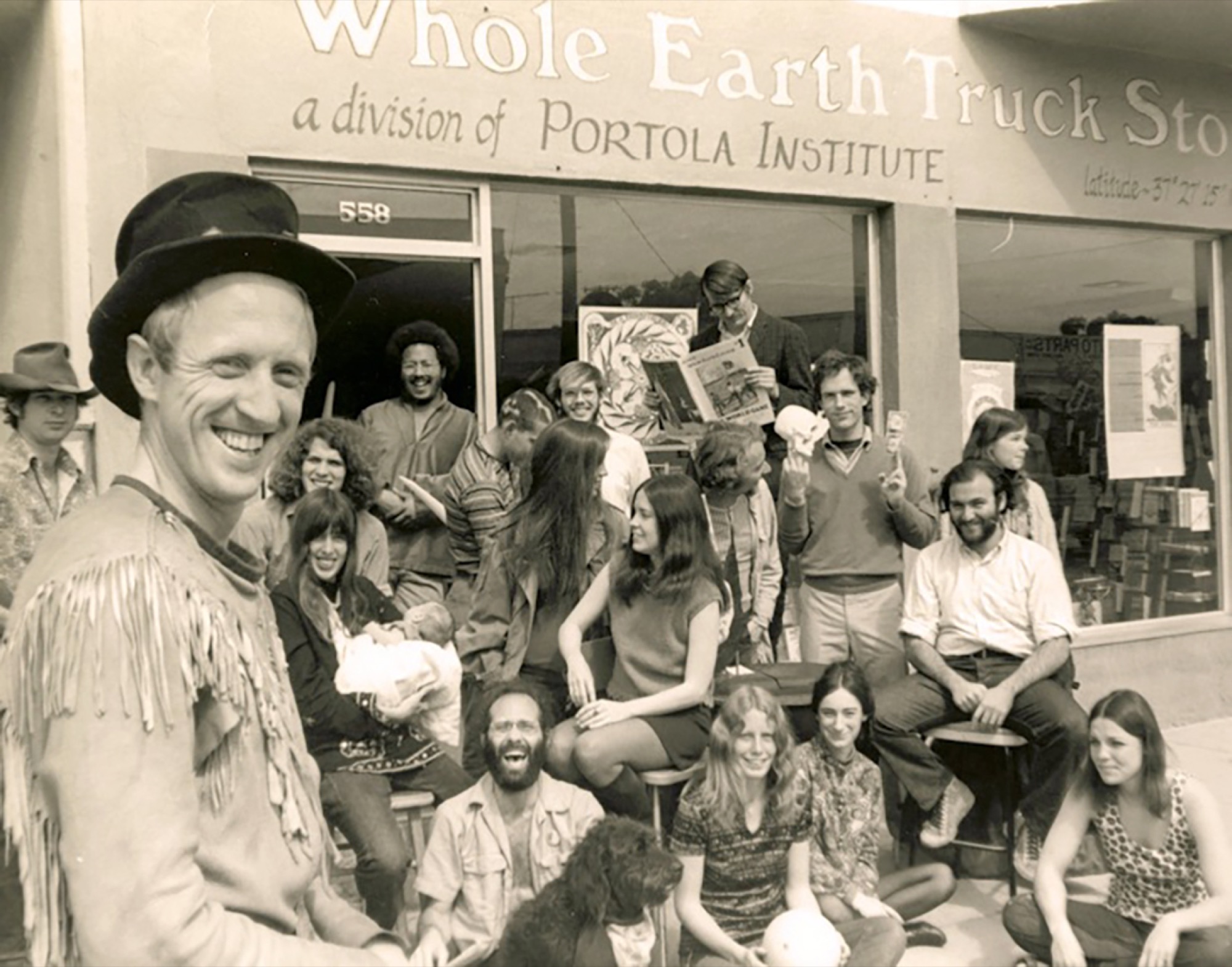
Stewart Brand and crew at the Whole Earth Truck Store, August 1969. The Whole Earth Catalog had launched a year prior; small-scale tools, access, consciousness-raising, suburban-on-a-commune. Courtesy Stewart Brand.
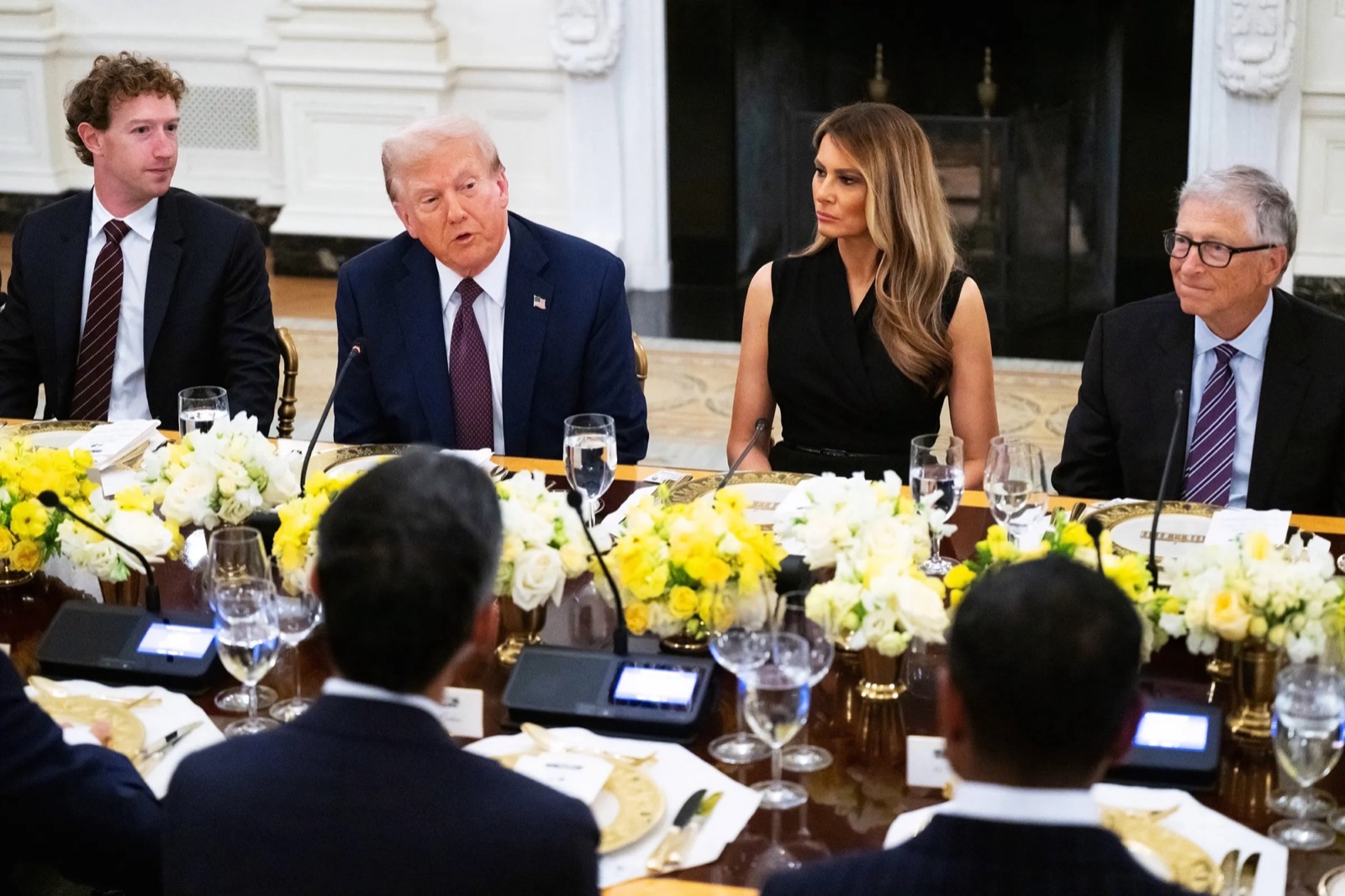
Bezos, Zuckerberg, Pichai, Musk, Cook seated together at Donald Trump's second inauguration, January 2025. Same industry, two centuries later, different relationship to power.
Jasmine Sun: I want to talk a little bit about the modern Silicon Valley subcultures. […] One being the big AI companies—OpenAI, Anthropic, etc. The other being the tech right, the defense, hard tech, Anduril, Palantir, SpaceX world. I'd love to hear your perspective on the unique styles and cultures of these. Tell me what the transition looks like from the Californian to the Texan ideology.
Fred Turner: The Texas ideology is really interesting. As you know, tech leaders since about 2020, but especially since 2024, have been moving their firms to Texas at scale. You might wonder why they're doing that. They'll tell you that California is a failed state, there are too many poor people, too much inequality. Never mind the fact that their companies are creating much of that inequality. But when they move to Texas, what they get is land, water, electricity, and a highly deregulated environment. They need that because computation itself has changed. In the '80s, '90s, and maybe even the early aughts, we were very busy building a global network. We were very busy building TCP/IP systems. In the '90s, pretty much every company in Silicon Valley was in some way connected to the internet, whether hardware or software.
At this point, the network is in place, and it's become an extraction system, whether it's Facebook and Meta, or it's AI. What we found a way to do is to transform the social world, in all its complexities, into absolutely humongous datasets, and then manipulate those datasets to reveal social patterns that are hard to see otherwise, and monetize them. To do that work, you need gigantic server farms. Those gigantic server farms need land, and they need to not be in small towns where people are going to complain about them because they're really noisy. They need to be near rivers or air supplies where they can keep them cool. Texas has all of those things.
One of the prices for that move, though, is an ideological shift. During the '90s and the peak of the California ideology, tech folks were able to lean on countercultural dreams of constant interconnection. It made sense—the counterculture wanted to build a world of shared consciousness, we'd just connect everybody.
Today, though, we're in a different world. We're in a world where we're pulling things out of the social world. We are miners now, and if we're miners, then the ideologies of Texas work really well. Texas is an extractive state. Texas is a state born on ranching and grassland. It's also born on the slave trade. […] One of the things we're seeing now is that as the tech world goes to Texas, they're starting to celebrate the Christian nationalist values that rule Texas.
Jasmine Sun: I want to talk about AI a bit because AI labs are also interesting in that they are no longer about connecting humans to each other, nor even necessarily about augmenting individual humans and their abilities. A lot of the way these AI labs talk, especially about AGI, is that we are creating this being that will surpass humans in capabilities. […] That feels distinct from the Facebook, Mark Zuckerberg, and Steve Jobs eras of how people thought about technology.
Fred Turner: Interesting. To me, it actually seems really consistent with the earlier era. That was the era when people said we're making a revolution, we're changing all of humanity, we're changing all of human experience. I have some old print ads from that period in my office at Stanford, and they really make it seem like we're going to go to the stars on the back of the internet.
When I think of the AGI rhetoric, it strikes me as being a lot like the network society rhetoric of the '90s. It says everything in the future is going to be different, and we're going to make it that way—come along with us. It hangs like an umbrella ideologically, and under the umbrella, many different specific beliefs can shelter because we're all going to the future together under AGI.
There's another piece here I want to flag, which we don't talk nearly enough about: the idea of masculine reproduction. This is an old theme of feminism, and it's one I think we're really living through right now. Men can't have babies. When they talk about birthing new technologies, birthing a new kind of life that will be better than life, what you hear is a masculine desire to be birth machines, to be the creators of things. You also hear a resentment of women and their capacities. That's where the world we're seeing in Silicon Valley starts to touch on the world of incels, the world of the right. That's where that weird, dark, right-wing masculinity starts to seem to make a little bit of sense. It's creepy stuff. It's all right below the surface, but it's all right there.