Jehan Chu: I'm not going to do any of the kind of get-to-know-you questions because I think that's pretty well out there. Let's start with where you are right now. When you think about your art practice — what is your art practice now?
Mike Winkelmann: That is a good question. I would say it is multifaceted, maybe too many facets. It's a mix of physical and digital ideas. The old way, or the way that I've made artwork in the past, which is much more like a painting trying to tell a specific story, and a new way of thinking about it that's much more generative and sort of ground-building systems.
Jehan Chu: Can you say more about that? Ground-building systems and generative. What does that actually mean in practice?
Mike Winkelmann: Just building systems.

Jehan Chu: Building systems. As practice?
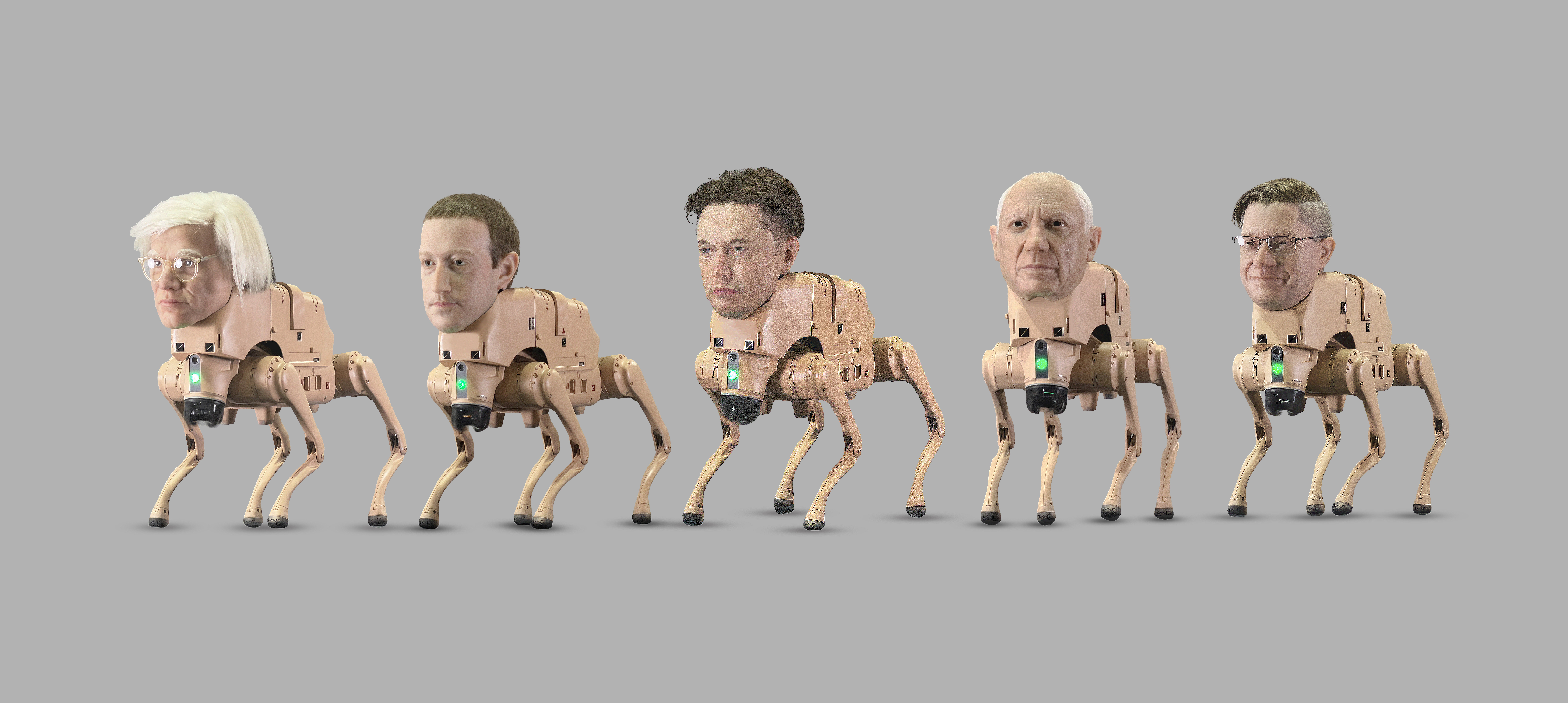
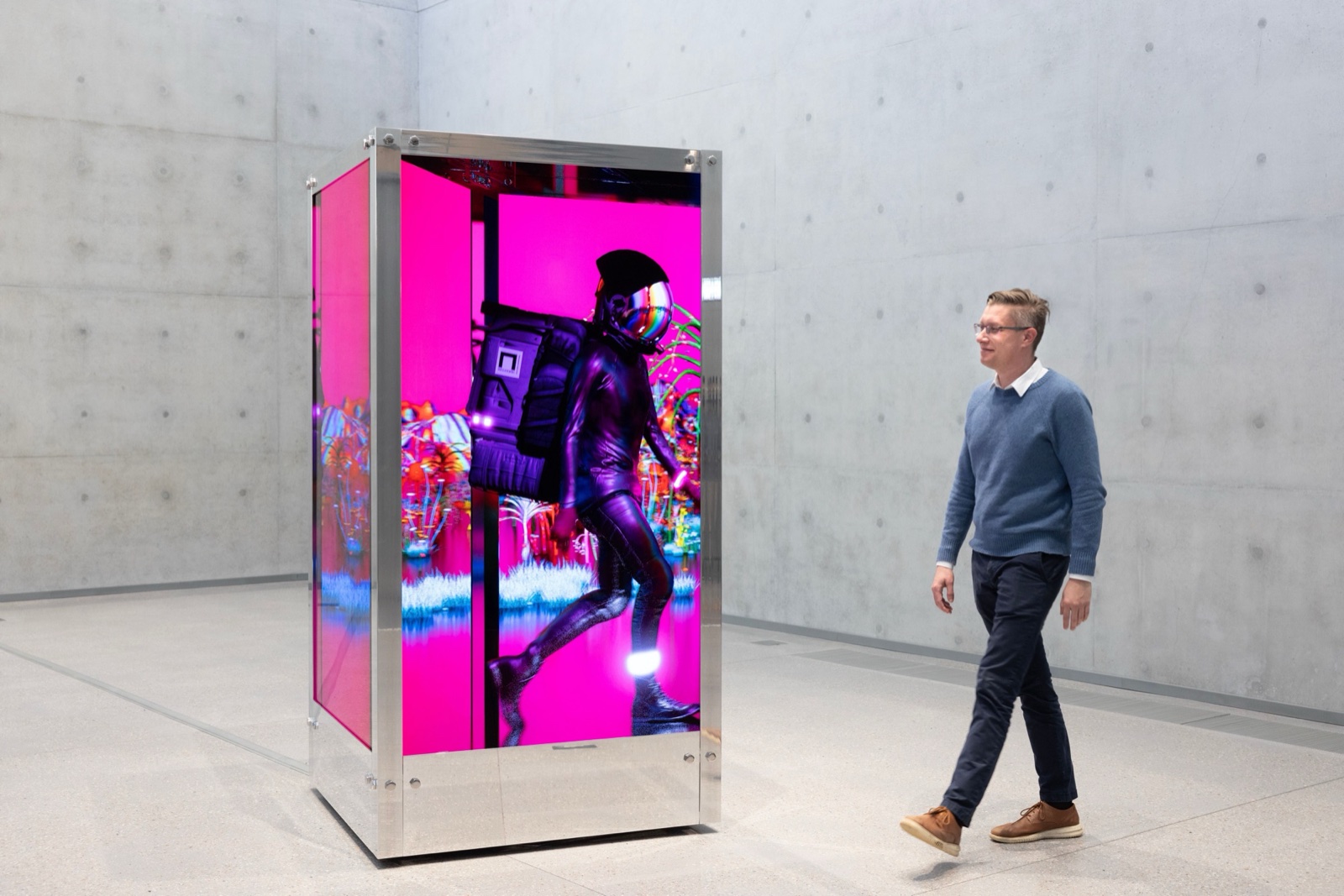
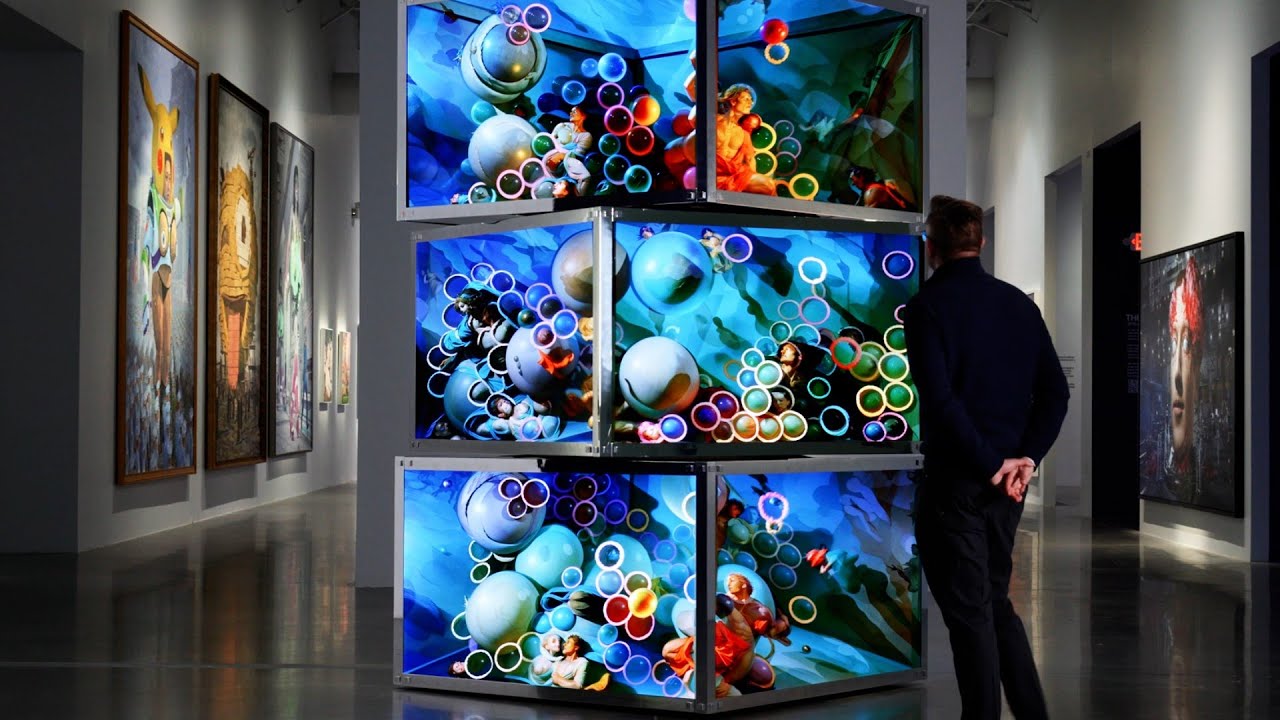
Mike Winkelmann: An example: DIFFUSE CONTROL, which obviously has generative AI, and is the driving force behind the sculpture, the piece, and the concept of it. Curators choose an image, and that image gets filtered through AI and creates another iteration of the piece. People are also able to generate prints from that as well. So that system and the rules of that system are the artwork and that's a new type of working from the way I worked in the past. I would make short films and they had a very specific narrative to them, or I would make EVERYDAYS, which obviously I still do. Those have a very specific narrative that I'm not generating that fits them, I'm saying a very specific thing. REGULAR ANIMALS is the same way.
You know, these sculptures that move around and take pictures and how often they take pictures and what they take pictures of and how the pictures are affected by AI. How the dogs move, all those things are systems and a different type of thinking than I've done in the past.
Jehan Chu: It's quite interesting because obviously systems-based work is very well explored, even from Sol Lewitt. The way that you're thinking about systems, because they are kind of either audience or other practitioner type of activation, or catalyst for these works — then also with REGULAR ANIMALS, you're bringing the audience into the practice as well. So some hearkening back to relational aesthetics, participatory artworks. Do you have that in mind when you're making these things? Or how do you come to these types of practices or strategies for your artwork? What's interesting about it for you to have either other practitioners, like curators, collaborate or even the audience. What does it bring up for you?
Mike Winkelmann: I think to me having the works be more interactive points to much more how we will view the true potential of digital art as a medium. And I think it's something that's not been explored pretty much at all. The first NFT works were not that, they're static pieces and they're self-generative.
Jehan Chu: Right. It was kind of like a one-way broadcast —
Mike Winkelmann: It was very — I hate to use the term — “shallow” but they were like your basic interaction, you know, when you press mint and it generates a seed phrase. It's a type of interaction but it doesn't say that much, like you're not able to communicate that much with the work. And so I think trying to find ways where people are having either intentional or unintentional ways of interacting with the digital works that are new and novel types of interactions that would only be possible now. And specifically I think a lot of it is with AI — it just opened up so many ridiculous possibilities, more and more each day than we have time to explore. Those are the things that are exciting to me because they're things I've never seen before. And it produces outputs that only could be made through this micromedia.
Jehan Chu: You mentioned that previous generations of generative art — like first-generation generative art — in terms of: you press mint, didn't have enough of the user or other point of view or input. It was a limited input. What is the final form or where does it all lead to for you in terms of your work, in terms of that type of interactivity or that user's point of view?
Mike Winkelmann: For me it's trying to explore. It's trying to give people a way to have a — it's very hard and I think I've scratched the surface, but there's a lot deeper to go — but I think it's giving users a way to interact with the works in a way that really tells them something about themselves. That they're like, “I’m surprised I did that,” or “I’m surprised.” Like, that was my instinct in how to interact with that thing. Those are the things that, to me, are exciting and interesting.
And there's many different ways to explore that. We've just scratched the surface with it. But most digital art in the future will be dynamic and interactive. I think that will be the default. Versus today where most art is — and this is like across the board — static. I don't think that will be the case in the future.
Jehan Chu: Do you see any bifurcation in terms of how people see art now that digital art hasn't really taken the world by storm yet? If you, if we look at both the art world and the “regular world,” I think personally that it's still some of the most undervalued art out there. You're shaking your head. So do you think that digital art is very popular?
Mike Winkelmann: Well, it's very — it depends on how you define it. If you define digital — if you define it as capital A digital art, then yes, I would agree. It's not been a huge part of the capital A art world. If you define it as more broadly speaking, how I look at it is like the visual language of almost everything we see, then I would say it's been very popular for the last thirty years — that almost everything you see, from movies to video games to advertisements to websites, all of those things were made by digital artists and people working in a digital environment. They were not made by painters, they were not made by sculptors, they were not made by photographers. They were made by people working digitally. And so in that sense, it's extremely, extremely pervasive. And I think it will even be more so now. With the advent of AI and anybody being able to make something in two seconds.
But yes, if you're just purely looking at it from the traditional art world, no, it hasn't had the — the medium has just been lumped in as like a fucking subcategory of mixed media. And not given its own category. This has nothing to do with VHS art from the ’70s.