Jen Vanegas Rocha: What are key professors, courses, exhibitions, and moments you experienced in San Francisco and SFAI that have affected your practice?
Mario Ayala: My first class, first painting professor, Carlos Villa. I mean, a hard one to ever forget. Carlos's relationship, although passive and easygoing because of just his age at the time — his impact as a painter who wasn't even necessarily making paintings with paint in a traditional way — that always left a mark on me. He was making paintings and sculptures and thinking about material in terms of his identity; those were all new concepts for me. […] Matt Borruso would also be one, Dewey Crumpler, Bruce McGaw — when I was there there was also already a lot of tenure faculty that have been there for several decades and I fortunately caught the last winds of them. Carlos Villa and Bruce McGaw felt more like forever impactful moments.
Jen Vanegas Rocha: I want to talk about your studio space because it's something that — every artist's personality influences the design of the spaces they create for themselves. Your office space in the studio has a wall filled with posters, ephemera, items that clearly are influential from your friends to Tupac and Snoop Dogg posters — you are working with all of that around you. Seeing this in your studio made me think about archiving. Can you describe your earliest memory of having that instinct of receiving something that's ephemeral and saying, "I want to keep this and hold it and reference it and experience it beyond this initial moment."
Mario Ayala: I think that natural instinct to collect and preserve in some ways — I've been doing that since I was in high school. The studio is a personal space and a space of making — whether it was a collage within my real workspace, now it's a little bit controlled in this room, my office. It's been an ongoing extension since maybe that time. A lot of these things I've been traveling with for at least the last decade of my life: everything from what friends have given me to ticket stubs, bracelets for shows, business cards, you name it…
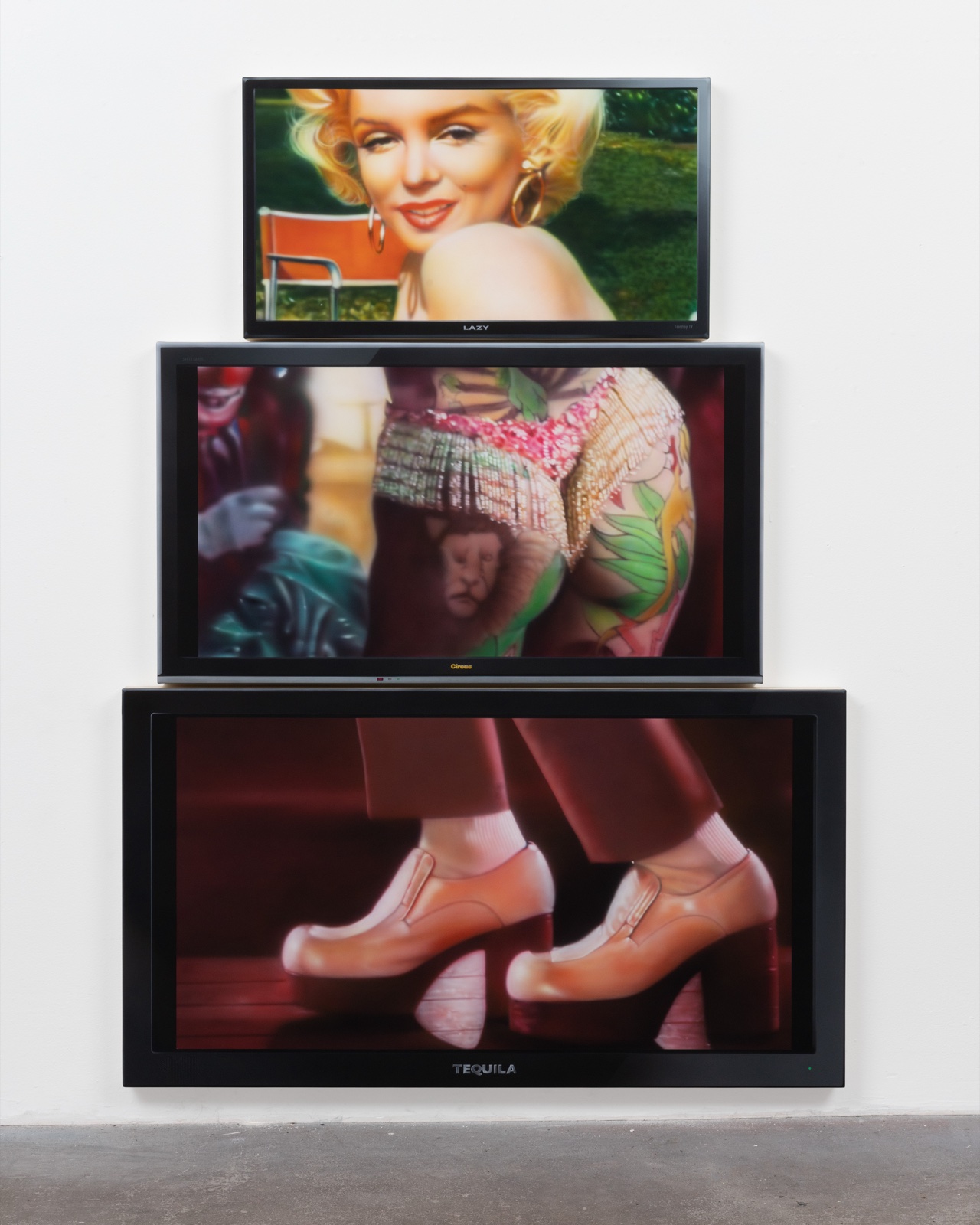
Jen Vanegas Rocha: When I see that layering and collaging of materials, I think about the layering that we see in artists like James Rosenquist — the way he used technology to create his images. When I went to your studio you also had some of the TV works, the canvases that are very similar to exquisite corpses — and it made a lot of sense that someone who lives with visuals in a personal space, in a studio space, can then see digital images via a phone, computer, TV screens, movie screens, is then able to collage. I'm sure you're using Photoshop and other tools to reach those forms, structures, layouts, compositions — but is there any connection with your experience in being able to create those physical spaces for yourself influencing the way that you then use digital images or photography in some of these exquisite corpse works?
Mario Ayala: The way that I compose paintings now in this collage format, I'm always collecting imagery in some way and making literal collages and making paintings, but before without having training in Photoshop and all those tools — I was doing a lot of collaging and layering physically. So drawing things and drawing multiple things to place in a space and see how something would lay out. So that feels like a more direct manual way of collaging which today I really do on the computer — drawing and collaging digitally. But that same thought of moving images around to be able to create compositions feels like a direct lineage to the way that I've been collecting imagery and making compositions for paintings. I think they've always begun in some collage.
Jen Vanegas Rocha: An exquisite corpse is a collaborative effort that has been employed by artists, like yourself and Ray Smith. You both are referring to this Surrealist technique, but you guys are skewing the game, it's no longer a group effort, you are reaching the final form by yourself. It's fascinating that you're diving into it and utilizing a digital space to reach the final composition. Where did the idea of deploying your forms in a similar vein as this Surrealist game come from?
Mario Ayala: I definitely have always been interested in Surrealism and realizing those games are typically multiplayer — I think it's something that we're introduced to as kids. But later realizing that this was a formulated technique from the Surrealists definitely interested me a lot more and makes sense in how these compositions become absurd and comical at times. It felt like a nice creative practice to get ideas out or to manipulate ideas.
So I've been making these series of TV composition paintings — they didn't really start out as exquisite corpses, but as a way to further explore an image that I was interested in, whether it be from a music video or film. I've also had this compulsive collection of video stills and screenshots. I've always just naturally done that. It's something that I've always referenced — whether it's direct, or not, in my work or in paintings. Thinking about the TV compositions that naturally happened while I was just looking at my stills and realizing that this could be a nice way to compose a painting. And later — there was a moment of chance where I was making these paintings and thinking about how some of these moments of limbs could fit with one another and create a portrait figuration. And that became more of an interest in a game by chance too — where things that I'm screenshotting end up being archived in these folders that I later refer to, to try and assemble some kind of figuration together.
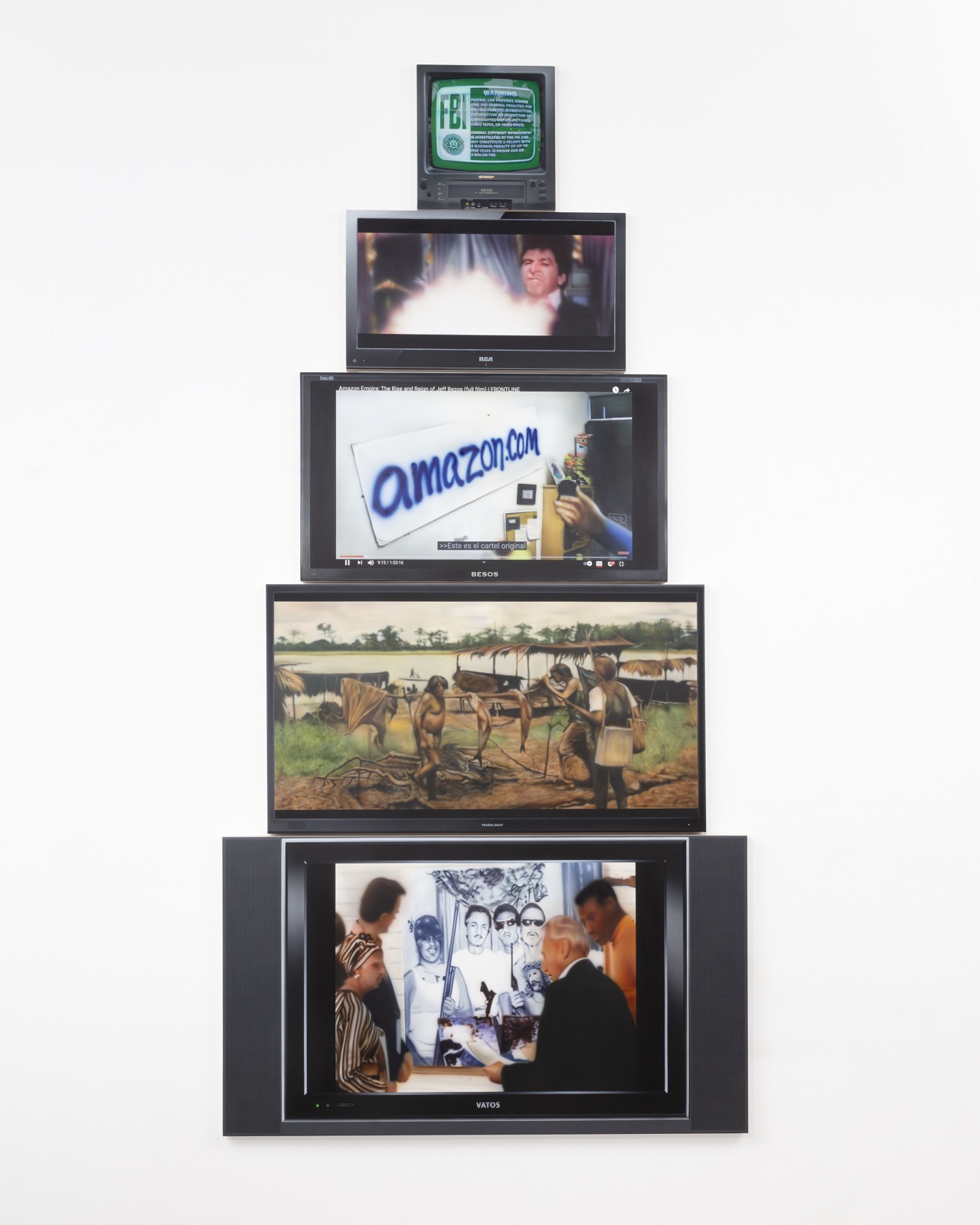
And I later started realizing that these Surrealist games had different kinds of variations to them. And there was this other one that I was really fascinated with called "picture consequences" and it's a similar idea of fitting images together that might not quite fit with one another. There is something about that term, "picture consequences," that I really enjoy. And I think the ways that these figures have been manifesting through collaging speaks directly to that.
There's also a clash of body parts or references that complicate the figure in a way that I'm really interested in. Just thinking about bodies — our own bodies and identity and masculinity, femininity and wanting to continue exploring just how far the absurdity can go or how it can be tamed at the same time.