Ed
Ruscha
Left: Add your take & reply on Threads @thecultureslop
Right: Read the full interview
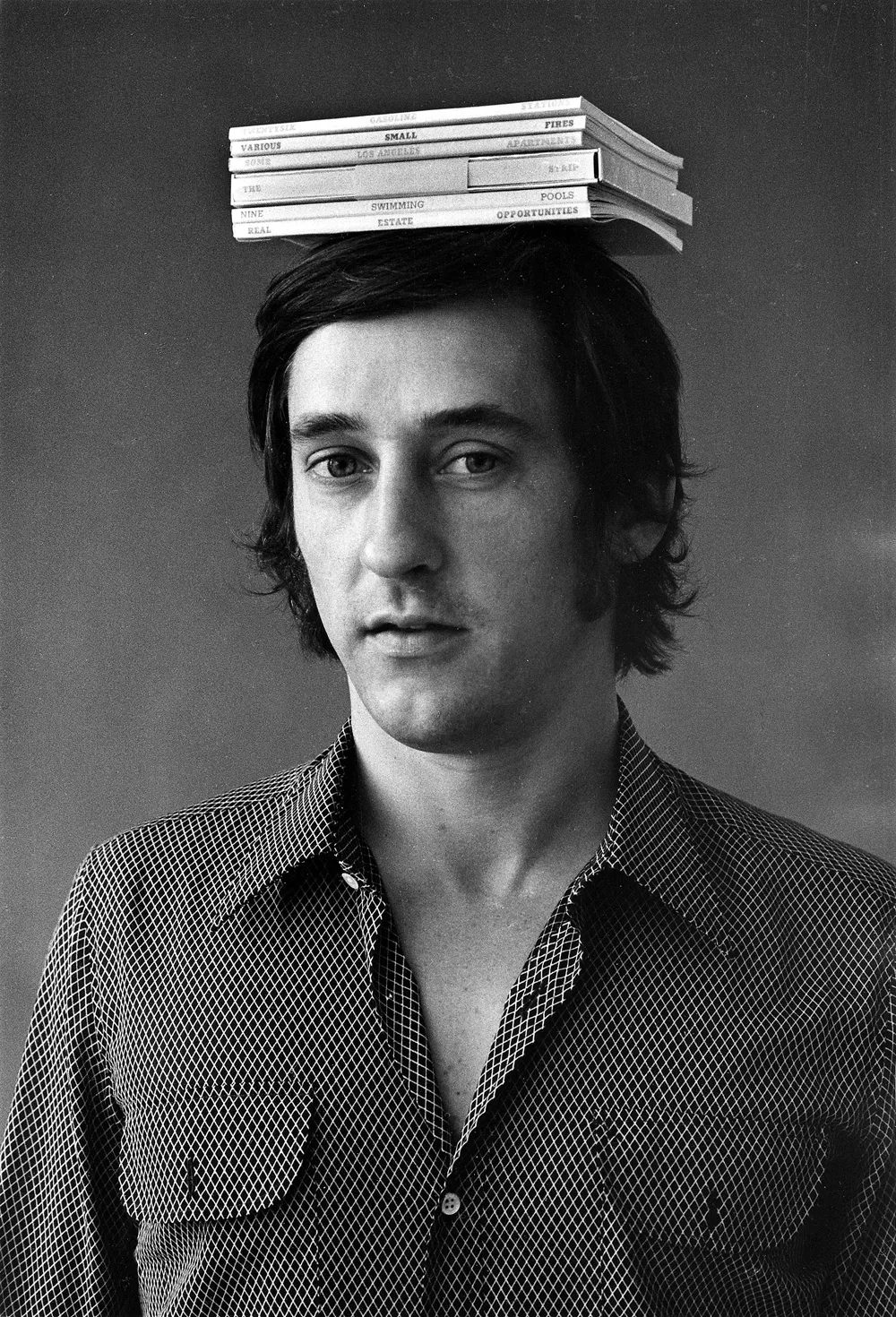
Ed Ruscha: In Conversation
With Andrew McClintock
I know you came out to California from Oklahoma with your family a few times beginning in 1949, but it seems that when you drove out here in 1956 in your 1950 Ford Club Coupe to go to art school is when California really bit you.
It was a four-door sedan and I came out here with my friend Mason Williams who wanted to be an insurance actuary, and I wanted to go to art school. I wanted originally to go to Art Center School, but their quota was filled so I had to go to this second choice, Chouinard.
Which is now CalArts.
Yes, and Chouinard turns out to be the bohemian school. Art Center School had a dress code. You couldn't have any facial hair, you couldn't have especially long hair, you couldn't wear sandals or wear a beret — they were trying to snip that in the bud. So then I thought maybe my being forced into this other school is going to do me some good. Art Center School had industrial design and all of that appealed to me, but finally Chouinard turned out to be better.
I'm going to pull a quote from your Smithsonian interview: "I didn't listen to Elvis Presley anymore. I became a serious person. I stopped going to church. The move to California was the big change."
Yes, I'd say that. There was a period of time when I was not keeping tabs on geopolitical events, so you might say I dropped out. I missed a lot of pop culture. I had no TV so I didn't know what Gunsmoke was. I had a period of about four years where I just was kind of out of public culture.
During this time you started to get turned on to Duchamp and Jasper Johns — were these artists in the incubator period that really started to turn you on?
Yes. And Duchamp — he had a very mysterious, quizzical, airy type of approach to making art, and a lot of my friends, we all sort of admired Duchamp because he decided out loud to quit painting and spend the rest of his life playing chess. We thought: how great could that be? Once you're dedicated you're supposed to stick with it, and here was somebody who was not going to stick with it.
After you graduated you took a trip to Europe for about 10 months — you made your first paintings with words there?
I was traveling and I carried a little painting kit with me where I would do these word paintings in hotel rooms. I came back through New York and went by Leo Castelli gallery and showed Leo my paintings. He was supportive. About 15 years later I had a show with him. When I got back to LA I had to support myself so I worked at an advertising agency doing layouts so I could get back to painting signs. Not hamburger signs. Not watermelon signs. But ones that were on canvas, like art signs. All my friends that were painters — we all wanted to make something that would just blow your hair back.
You've been painting words for so long you said you forgot why you were doing it — and then the question came.
The word SPAM sounds like a gun going off, and I was kind of wrapped up in that spirit. I concentrated on monosyllabic words, utterings — "pow," things that come from comic books. And then I thought: am I painting pictures of words or am I painting pictures with words? And the question is always out there, and I'm glad I don't understand it.
Twenty Six Gasoline Stations — you called it a "sideways jump" from painting.
I knew it was a sideways jump away from painting and I felt like it was a risky thing to call it my art, but I definitely felt like the book was a piece of art. I almost needed an excuse to make a book. The excuse was the photographs I took of gas stations. I learned how to set type by hand, worked for a fine art book printer named Saul Marks, and after I did that one book — it's not enough, I've got to do another one. And then it just kept happening.
The pop art show poster — you dictated it over the phone to a commercial printer?
Our backs were at the wall. We had no time. I called up Majestic Poster Press — they did circus posters, boxing posters — and I just gave them the copy and told them to make it loud. I liked the idea of remote control creation. Sometimes you're given too much time to think about something and you dwindle and dawdle and never get anything really good. In this case it was spontaneous, quick, somebody else made it, and it ended up being a beautiful poster.
Every Building on the Sunset Strip — two and a half miles, both sides of the street, accordion fold.
I like the idea of recording the elevation of a phenomenon. They began to appear as though they were almost like a movie set — all façade. I wanted a demographic approach: no agenda, everything just fits together. LA is quickly changing. If you've never been there you should see it before it gets swallowed up. It's turning into a turbocharged theme park.
You joined the SFMOMA board in 2013. Why San Francisco?
I've thought about this carefully: San Francisco is the most beautiful city in the world. It's got a mystery to it that hit me when I was a kid and visited there. It still maintains that mystery. Any time I get an opportunity to go to San Francisco I do.
What's your work ritual? How do you show up to the studio?
I follow a predictable pattern of spastic, jerky motivations. These are motivations that are puzzling to me to this day. I do not follow astrology but my sign says that I do unimportant things first.
If there was one movement you would relate to most — conceptual, pop?
It's amusing to see how so-called "movements" evolve and dissipate, and how certain artists eventually evade and fly off from their positions in a given movement. Nothing seems absolute but all art seems to be made out of other art. I don't know where I belong and I'm content that way.