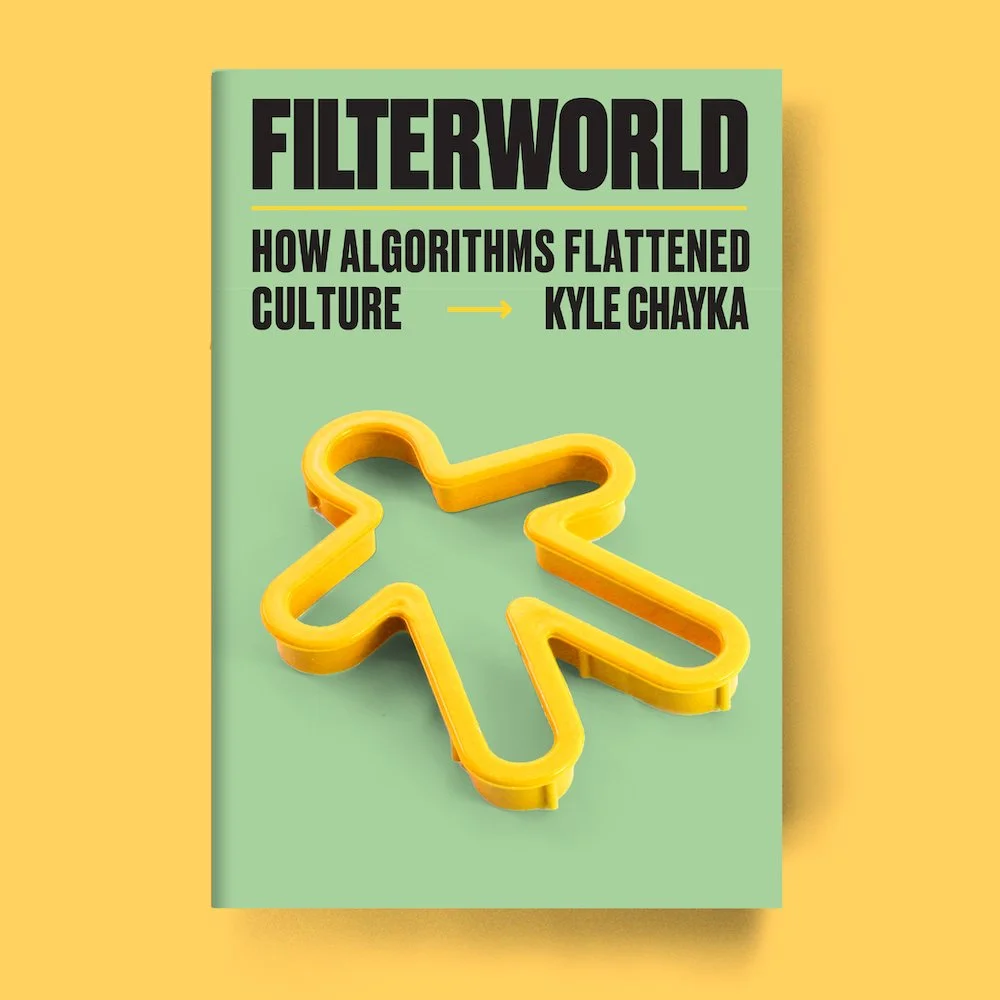
Andrew McClintock: Your book Filterworld was this spark for me to eventually end up doing…what I'm doing now with Culture Slop. Thank you.
Kyle Chayka: Thank you for reading it. I think the goal in writing the book, as much for myself as for anyone else, was to make us think differently about the online ecosystem that we're in. Because I think you do get so embroiled in it so easily. The technology is addictive. It's meant to be frictionless. It's meant for you to not think about it. So when you step back and you do think about it, it becomes pretty weird pretty quickly.
Andrew McClintock: Why don't we just recap a little bit on algo recommendations. Obviously Netflix, TikTok, Spotify — would you include LLMs like ChatGPT and Claude in that now as a 100x multiplier? And how does that impact the same thesis you had in your book?
Kyle Chayka: I wrote the book really before Generative AI was a public product. It was prior to OpenAI's first release of ChatGPT. So it's really like the book was written without that context at all — it was a surprise to everyone, it just kind of struck a tidal wave. But I think generative AI just continues the problems that algorithmic recommendations have started. Machine learning, the previous word for AI, is also behind algorithms and it's behind anything that learns your habits and predicts your actions. So I think my thesis was that algorithmic feeds produce homogeneity and they do that by encouraging all of the users to kind of move in a herd in the same direction. They incentivize homogeneity by promoting things that are the most clickable to the highest number of people.
Andrew McClintock: And what does that mean for subcultures or the opposite of something that's homogenized? Subcultures with thoughtfulness, niches, I obviously still see aspects of that online, but it feels shallow or hollow — but it's tricky, right? I can't really figure out — I can't grab the knife.
Kyle Chayka: It's tough. This is the real problem that I have been confronting. And I think stepping back a little bit, the Filterworld book was about the 2010s. It was the period during which algorithmic social media emerged and became popular and then became so dominant that we can't imagine a world without it. And this was before TikTok took over America. So I think there are lots of effects that I observed happening and saw happen and many things that have kept happening that are now producing more effects and more homogenization and an even further flatlining of culture, let's say, and I think the phenomenon that is the hardest to catch or get your hands around or capture is this death of subculture in a way. I think what causes the feeling is that any cultural innovation that happens now gets absorbed and accelerated into mainstream culture within a matter of days or maybe weeks. If you're lucky, your niche creation will stay niche for one week and if it's cool enough, it will then blow up to millions or billions of people.
Andrew McClintock: You and I both come from the same generation where there was a craft of following the treasure map of the clues or the breadcrumbs of culture that you would pick up from the older kids or the random thing that you read in the magazine. And maybe it's a little too nostalgic or too much importance placed on this act of doing that, but I remember it as being so special.
Kyle Chayka: People talk a lot about friction now. I think they weren't so much, six years ago, when I started to write the book. But friction is the difficulty of accessing culture and participating in it. Some things that you have to learn about slowly, things that you have to gather signs and symbols and gather understanding in order to be involved in.
Andrew McClintock: Do you think part of this is there's a corollary to how critical thinking, humanities, arts education in schools has obviously gone off a cliff? And are people more scared to experiment and fail and fail in public? How do those two things impact all this?
Kyle Chayka: Do you mean failed experiments in terms of being a consumer or being a creator of stuff or both?
Andrew McClintock: Being a creator of stuff. In another conversation I had for this issue of Culture Slop, we spoke in-depth about Isaac Newton and experimentation and how it's needed to push humanity forward — obviously no one's going to be Isaac Newton again, but that concept of loose experimentation just making something just to do something weird.
Kyle Chayka: The desire not to be weird is a strong one in this time. […] I think that deep solo time in the studio, where a visual artist goes away for three years and shows nothing to anyone and just has conversations in their own head and then comes out with something amazing — I think that's the ideal model for art-making, probably for the artist or creator to surround themselves with just what they want and to go into that hole and not feel the pressure to perform and create in public constantly.
On the consumer end, I think liberal arts education and liberal arts practice — you don't need to go to a college — is that education begets better cultural consumption like understanding something critically, knowing history makes you more appreciative and more understanding of a piece of art.
Deep reading in any context is the goal of liberal arts, and so if we're not trained in that practice and we don't value it, then we're also going to consume art in a shallow way.
If all we want from our art is passive entertainment and ambient soothing feelings, then that's what we're going to get.
Andrew McClintock: Yeah. Wow. I've seen a couple things online going on recently and I feel like they are part of this ongoing conversation around taste. What is taste?
Kyle Chayka: I'm literally writing my next column about the taste thing and the tech-bro adoption of taste — there's a fever pitch of taste is the moat. If AI is successful, all that matters is your personal taste. […] It's a personal emotional understanding of something that shifts your soul or moves your life in a new direction or makes you think differently about yourself. I think there's a difference between taste as a superficial preference or a knowledge of what's fashionable versus taste as a deeper understanding of what cultural things mean to you and what is meaningful to you. In tech and business, taste is just the profit motive, taste is knowing what might make money, and in the philosophical sense, taste is what makes you a human individual, a unique person with a soul. So the two are very separate. To me, it's social media co-opted attention. Now AI will co-opt tastes.
In writing Filterworld and in talking to a lot of people, it's clear that algorithmic feeds really destabilize people's sense of their own desires and tastes, like they don't trust their own enjoyment of something outside of the context of the feed. They have anxiety about their taste.